
Community Hacking: Stop Casting Nets. Start Scouting Whales.

When I joined Space Ape Games in 2015, I started where a lot of people in games quietly start: support tickets. It was the fastest way to understand the game, the players, and all the strange little problems that never show up in a product roadmap.
Pretty quickly, though, I found myself helping with something else. It didn’t really have a proper title. It sat somewhere between community management, sales, marketing, live ops, and growth.
At the time, we called it community hacking.
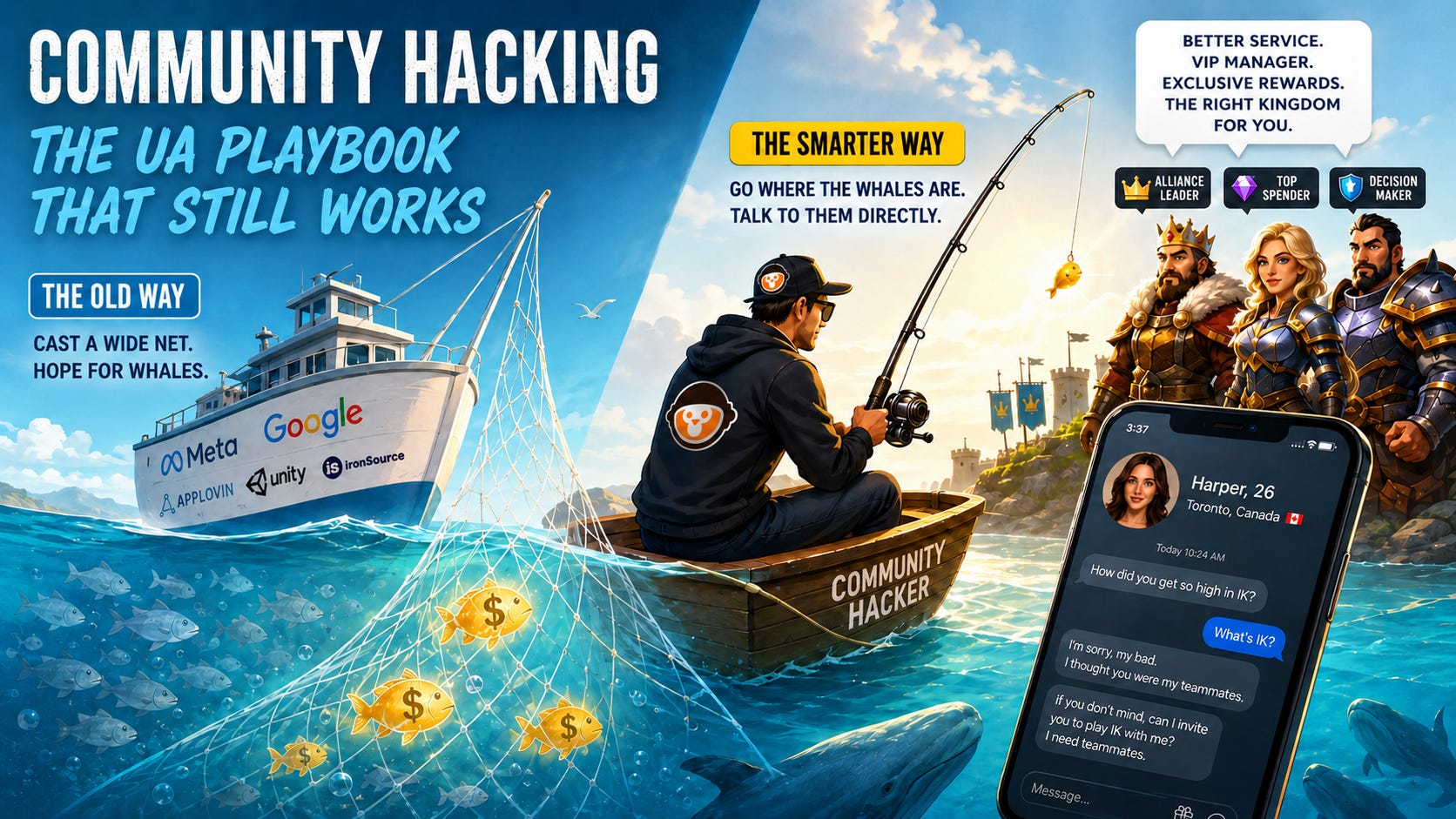
The concept was straightforward. Go into competing games. Find the top 100 or so alliances. Identify the decision makers - the guild leaders, the big spenders, the people other players listened to. Then pitch them. Hear their gripes about the game they are currently in. Tell them you can give them a better service in your game, have access to a VIP manager, accelerate their progress with promo codes, and help find them a kingdom suited to their style of play. Get them in. Those promo code redemptions let us attribute installs and spend directly to the effort.
For Rival Kingdoms, I can remember pulling the lifetime spend reports on the players we’d brought in this way. The number was around $500k and this was maybe a year after the efforts which only lasted a month or two. So given the game was sunset on August 24th, 2024 it’s safe to say that number crept much higher over the years as a lot of those players were there till sunset. And the cost to acquire them? Time from salaried employees. Definitely a largely profitable endeavour.
Most UA today works in the opposite direction. You cast the widest possible net across Meta, Google, Applovin, Unity, Ironsource, and whatever else is hot that quarter. You’re hoping the right person sees the right ad at the right moment. Some of them convert. Most of them don’t. And whales - the players who will spend thousands over their lifetime - get treated the same as everyone else in that funnel, because there’s no way to filter them out before they install.
Community hacking skips all of that. You’re not hoping a whale sees your ad. You’re going to where the whales already live and talking to them directly.
The targeting is better than anything an ad platform can offer, because you can see exactly how someone behaves in a game before you approach them. Alliance rank. Activity level. Garrison power. Whatever the metrics are for the title you’re fishing in. You’re approaching someone with proof that they’re the kind of player you want.
I’ve been thinking about this a lot recently because I’m watching a new version of it play out, and it’s impressive in its own way.
The game is Infinity Kingdom, published by Yoozoo. And the method is Discord.
For context: On iOS it sits at #160 in Strategy for Downloads, pulling around 30k installs and $1M in revenue last month. On Google Play it ranks higher - #88 in Strategy - with 50k downloads and another $1M in revenue.
Over the past few months, I’ve been joining more Discord servers tied to mobile games - occupational habit. And I started getting random friend requests. At first I ignored them. Then I got curious.
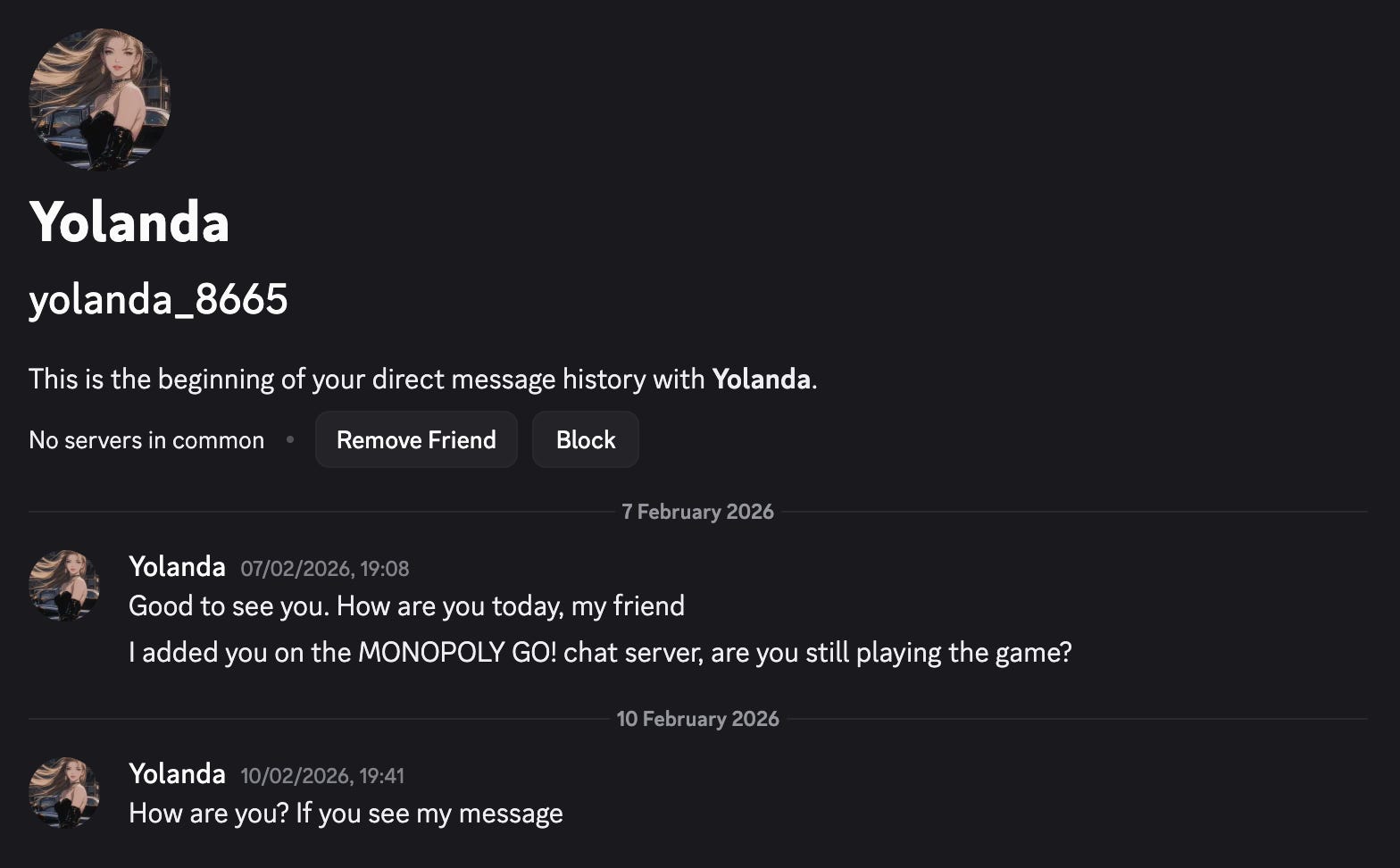
The first message was from someone called Yolanda. Profile picture of an anime woman, casual opener, nothing that screamed anything in particular. I didn’t respond.
Then Harper, 26, from Toronto. She opened with “How did you get so high in IK?” I didn’t know what IK was, and I hadn’t responded, so she followed up with: “im sorry, my bad. I thought you were my teammates.” Then: “Oops. I’m so embarrassed. If you don’t mind, can I invite you to play IK with me? I need teammates.”
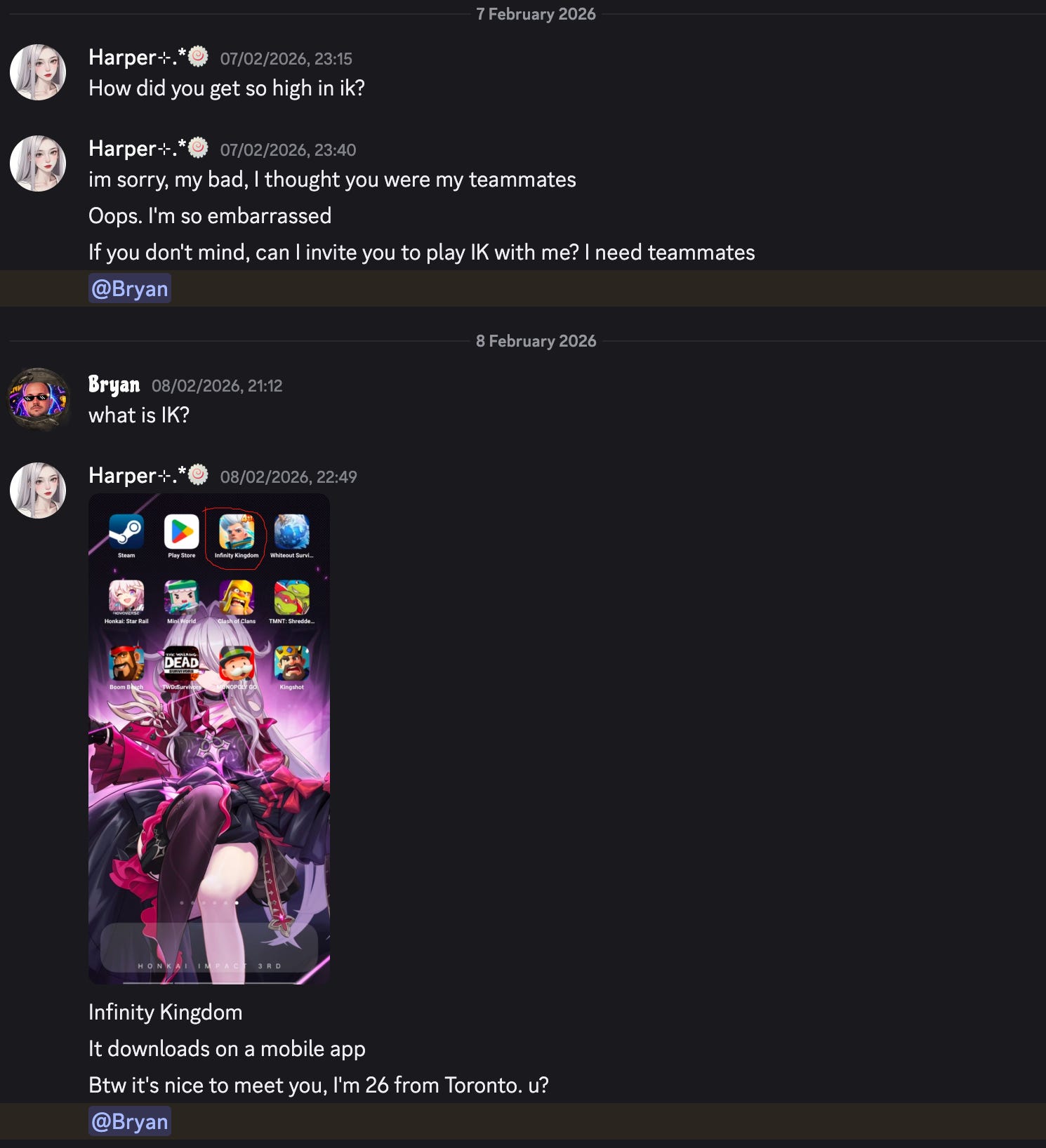
I asked what IK was. I got a screenshot of a phone with Infinity Kingdom circled.
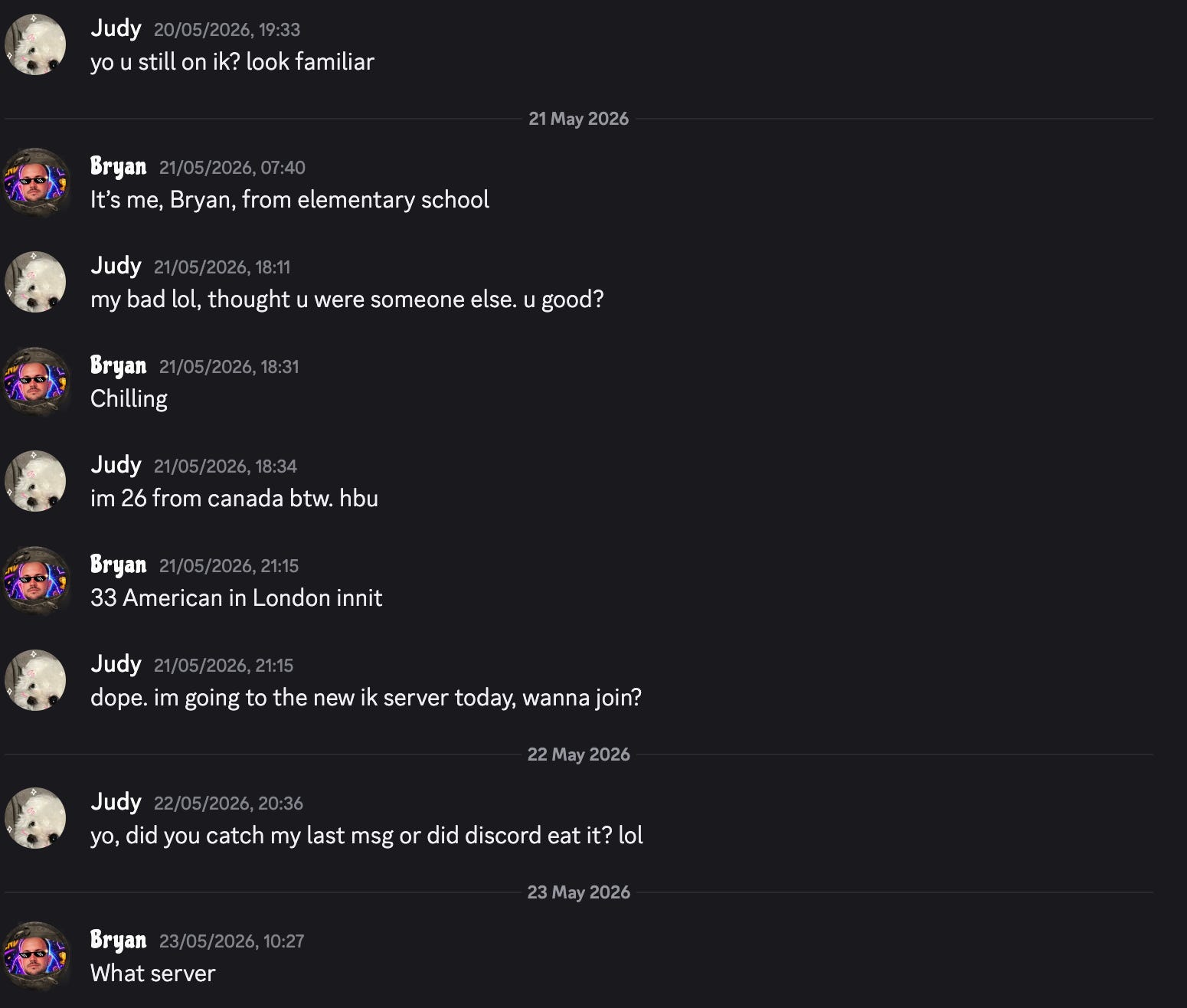
A few weeks later, Judy. “yo u still on ik? look familiar.” I played along and said “It’s me, Bryan, from elementary school.” She didn’t miss a beat. Carried on. Told me she was 26 from Canada - same age and location as Harper, worth noting - and said she was heading to a new IK server and wanted to know if I’d join.
I stopped responding. She followed up. “yo, did you catch my last msg or did discord eat it? lol”
I caved, asked which server, and got funnelled into Infinity Kingdom. Once I said I’d signed up, Judy rang me on Discord audio. I didn’t answer. She asked for my username. Once she had it she told me to join her alliance and start working through the tutorial to level 5.
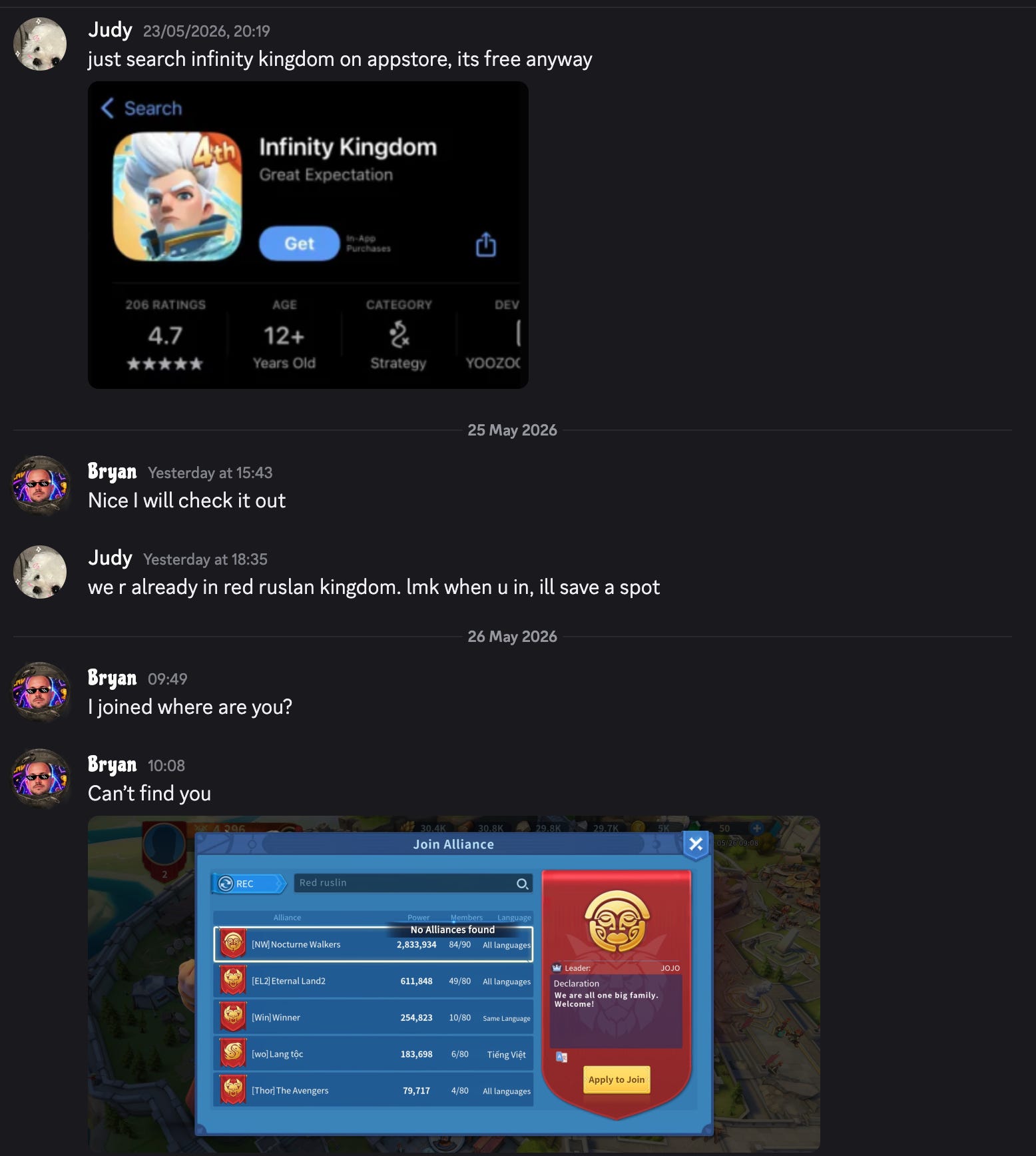
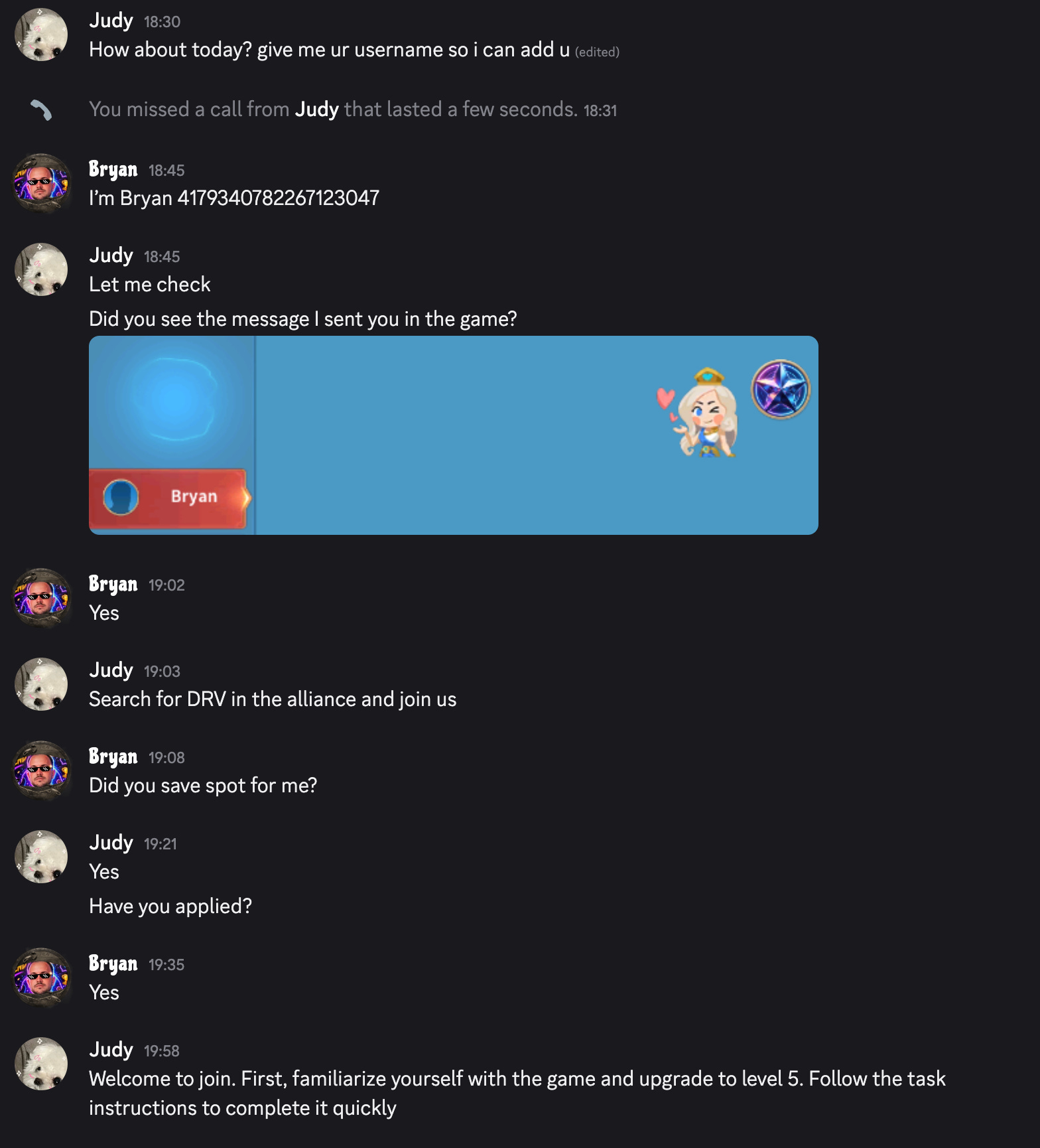
I stopped the conversation after that as I knew where this was going. First get to level 5, then eventually make a purchase etc. etc….
This is not a scam. It’s a well-built affiliate operation.
The people running these conversations are likely working on CPA, using in-game screenshots and usernames as proof of conversion before getting paid out. The playbook is deliberate: attractive female profile picture, casual opener, manufactured coincidence (”I thought you were my teammate”), same age and location across accounts to build a consistent persona, and escalating urgency once you show interest.
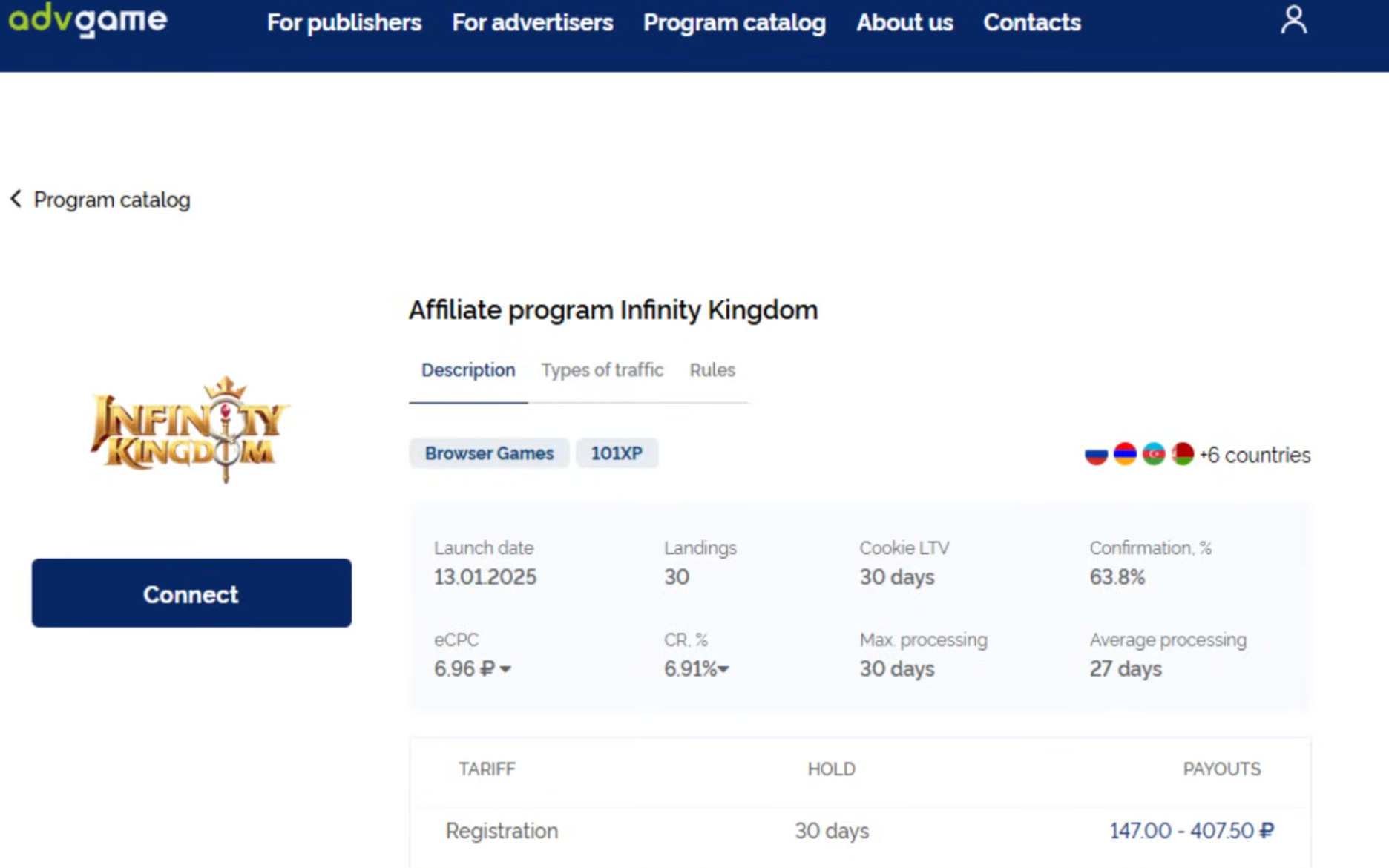
The targeting is not random either. One Reddit thread I found had people noting they’d received these messages while in Monopoly Go servers, DC Dark Legion servers, Avatar Realms Collide servers, cozy game servers. The people running this are looking for mutual servers with their targets before reaching out. They’re fishing in known waters.
And by the numbers on YouTube, where a video documenting this has around 41,000 views, the volume of people hitting this funnel is significant.

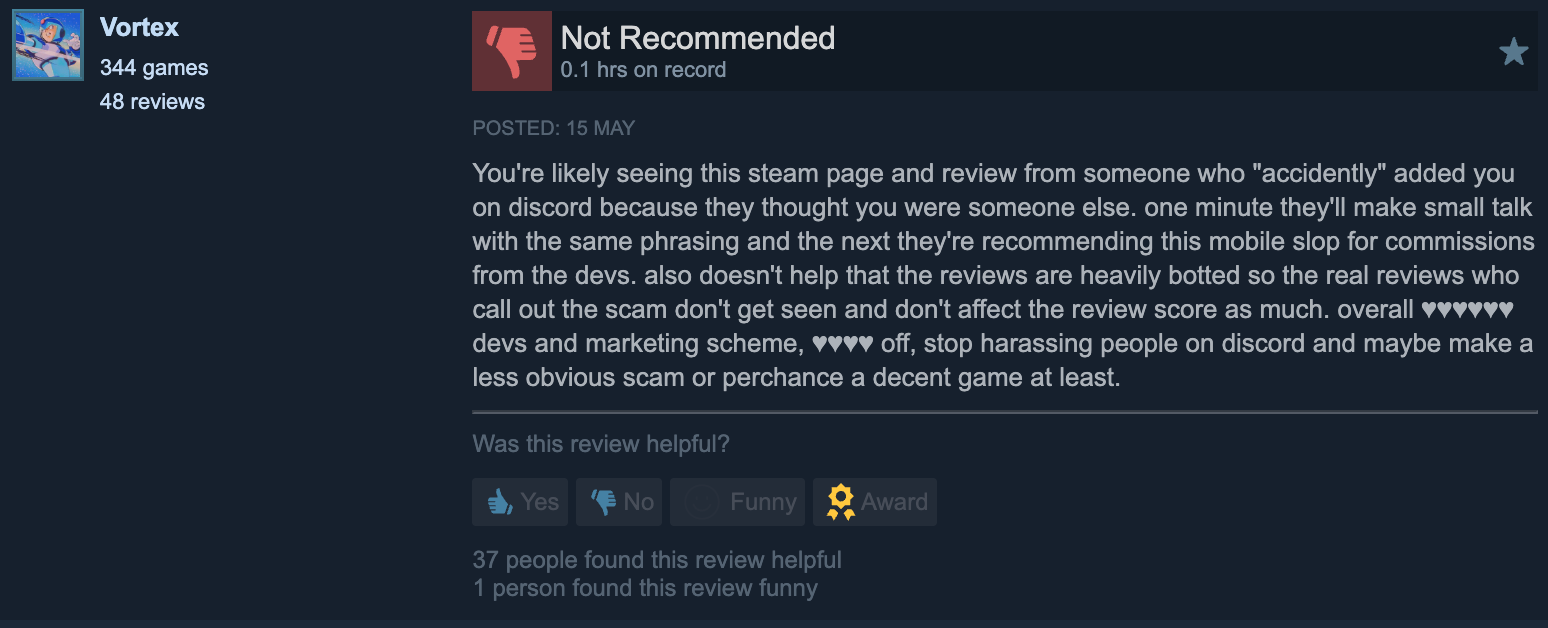
There’s a cost to doing it this way though. A quick look at Infinity Kingdom’s store reviews and its Steam page shows a pattern of players calling out the fake Discord accounts, warning others it’s a scam, and leaving one-star reviews as a result. The operation is generating noise in exactly the places a new player would look before installing. Yoozoo probably don’t care - the affiliate program is clearly converting enough to justify the blowback, and strategy whales aren’t typically browsing App Store reviews before they spend. But it’s worth knowing the trade-off if you’re thinking about running something similar.
The version that actually works, and the one we ran at Space Ape, doesn’t need a fake persona. If you want to community hack properly, either invest time building a legitimate high-level account in the game you’re targeting, so you have credibility when you approach top alliance players, or find someone already playing your game at a high level and bring them in as a scout. A real player in a real alliance, making a genuine pitch to someone they’ve actually played alongside, will convert better and leave zero negative reviews behind.
The whales are out there. You just have to earn the right to talk to them.
As always, if you've seen versions of community hacking in the wild - or ran a program like this yourself - I'd love to hear about it in the comments.